


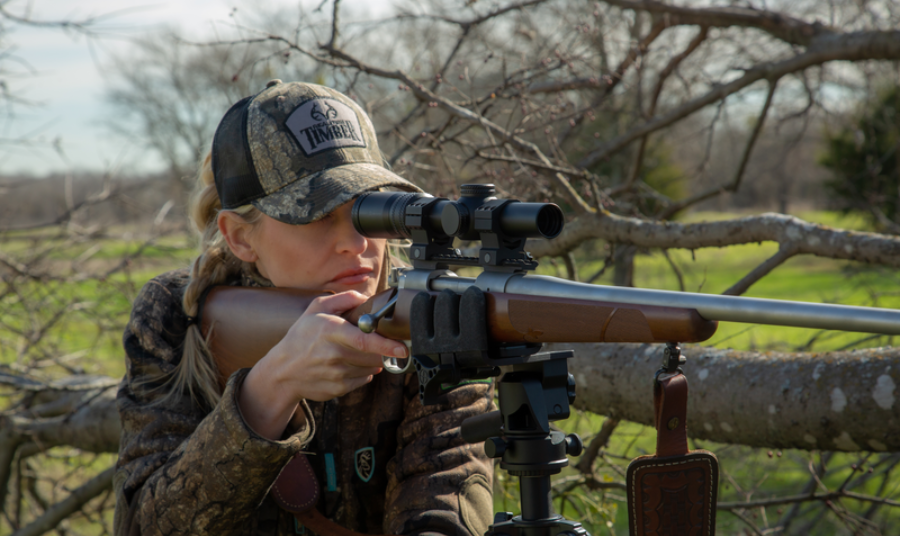
The KJI Titan and Nomad ballheads take two different approaches to tripod control. Compare their size, weight, capacity and adjustment systems to find the better fit for your hunting setup.
A good hunting tripod is only as useful as the head sitting on top of it. The tripod provides the foundation, but the ballhead determines how easily you can move a rifle or optic, follow an animal, make small aiming corrections and lock everything into place.
Most hunters are familiar with the standard ballhead. It uses a ball inside a fixed housing to provide movement in several directions while controls on the body adjust resistance or lock the head in place. An inverted ballhead changes that arrangement.
KJI offers both approaches. The KJI Nomad Ballhead uses a conventional ballhead layout with separate tension and quick-lock controls, while the KJI Titan Inverted Ballhead uses an inverted design built around a larger 60mm ball and a simplified control system.
Neither design is automatically better for every hunt. The right choice depends on what you are carrying, how you use your tripod and how much weight you are willing to add to your pack.
Choose the Nomad when lower pack weight and a dedicated quick-lock control matter most. Choose the Titan when you want greater load capacity, a larger 60mm ball and a simplified inverted control system for heavier rifles and optics.
What Is an Inverted Ballhead?
On a conventional ballhead, the ball moves inside the main housing while the adjustment controls remain attached to the body of the head. The shooter adjusts those controls to change resistance, reposition the rifle or optic and lock the ball in place.
The Titan changes that relationship. Its oversized tension knob travels with the ball as the head moves, which keeps the primary adjustment control within reach at different shooting angles. KJI designed the Titan around only two main user controls: the tension adjustment and the ARCA clamp. There is no separate pan lock that the shooter has to find while repositioning the rifle.
That simplified layout becomes especially useful when working around an awkward shooting position. If you are kneeling on a slope, sitting behind brush or tracking an animal across uneven ground, the head may be tilted far away from its neutral position. Keeping the main adjustment control with the moving portion of the head makes it easier to find without looking away from the rifle or optic.
The standard Nomad takes another approach. Its tension knob lets the hunter establish the amount of resistance desired during movement, while a separate quick-lock lever can immediately change the head from movable to locked.
The difference comes down to workflow. The Titan emphasizes simplicity. The Nomad gives the shooter another dedicated control.
Inverted Design
- 60mm ball
- 60-pound maximum load
- Tension control travels with the ball
- Simplified adjustment system
Standard Design
- 40mm ball
- 30-pound maximum load
- Adjustable tension control
- Separate quick-lock lever
Titan vs. Nomad Ballhead Specifications
| Specification | KJI Titan Inverted Ballhead | KJI Nomad Ballhead |
|---|---|---|
| Ball Diameter | 60mm | 40mm |
| Maximum Load | 60 lbs. | 30 lbs. |
| Weight | 2 lbs. | 1.1 lbs. |
| Dimensions | 4.52 x 4.44 x 3.93 in. | 4.21 x 3.75 x 3.42 in. |
| Panning Range | 360° | 360° |
| Tilt Range | 90° | 90° |
| Clamp | ARCA Swiss compatible | ARCA Swiss compatible |
| Bubble Level | Top mounted | Top mounted |
| Tripod Interface | 3/8"-16 | 3/8"-16 |
| Material | Aluminum | Aluminum |
| Current Price | $349.97 | $249.97 |
The Titan's official specifications list a 60-pound maximum load and a weight of 2 pounds. The Nomad uses a smaller 40mm ball, carries a 30-pound maximum rated load and weighs 1.1 pounds.
Both heads provide 360-degree panning, 90-degree tilt, ARCA Swiss compatibility, top-mounted bubble levels and standard 3/8"-16 mounting interfaces. That means both can serve the same basic hunting roles and work within the same KJI tripod ecosystem.
The important differences are capacity, size, weight and control.
Why Choose the Titan Inverted Ballhead?
The Titan's 60mm ball is considerably larger than the Nomad's 40mm ball, and its maximum rated capacity doubles from 30 pounds to 60 pounds. That gives hunters more headroom for heavy rifles, large spotting scopes and rifles carrying additional equipment such as suppressors, thermal optics, night vision devices or other accessories.
Most ordinary hunting rifles will never approach a 60-pound static load. The advantage is not that a hunter needs to place a 60-pound rifle on the tripod. The larger ball and higher capacity provide a more substantial platform when the equipment mounted above it becomes heavier or more demanding.
The control layout is equally important. Instead of moving between several adjustment points, the Titan gives the hunter one large tension control that remains accessible as the ball moves. Once the desired amount of resistance is established, the shooter can move the rifle through its available range without continually searching for another control.
This can be particularly useful for precision rifle hunters who spend significant time behind the tripod. During a long observation or shooting session, small differences in adjustment become noticeable. Fewer controls mean fewer things to manipulate while transitioning between scanning, aiming and locking onto a target.
There is a cost for that strength. The Titan weighs 2 pounds, almost a full pound more than the Nomad, and its dimensions are larger. It also costs $100 more at current KJI pricing.
For a hunter carrying equipment a short distance from a vehicle, blind or established shooting position, those differences may matter very little. For someone climbing several miles into the backcountry, they matter considerably more.
Why Choose the Nomad Standard Ballhead?
At 1.1 pounds, the more compact Nomad saves almost a pound compared with the Titan before the hunter even considers the weight of the tripod. Its smaller dimensions also make it easier to fit into a hunting pack or strap to the outside without creating as much bulk.
That matters because hunting equipment is cumulative. A few ounces from a rifle accessory, a few more from optics and another pound from the tripod head eventually become several additional pounds that have to be carried up and down the mountain.
The Nomad's 30-pound maximum load is also more than enough for many hunting setups. A conventional hunting rifle with an optic, an ARCA rail and common accessories remains well below that figure.
Its control system also offers an advantage of its own. The tension knob establishes how freely the ball moves, while the quick-lock lever lets the shooter immediately freeze the head in position.
Consider a hunter glassing across a hillside. The ballhead can remain under controlled tension while the hunter scans. Once an animal is located and the rifle or optic reaches the desired position, the lock can be engaged immediately.
The Nomad also uses square-knurled controls designed for operation with gloves, something that becomes useful during late-season hunts when exposed metal controls and cold fingers are a poor combination.


Which Ballhead Is Better for Backcountry Hunting?
For hunts where weight and distance matter most, the Nomad has a clear advantage.
Saving approximately 0.9 pounds may not sound dramatic on your truck, but after several miles of elevation change with a rifle, ammunition, water, optics, clothing and other equipment, that difference becomes easier to appreciate.
The smaller Nomad also retains the basic capabilities most hunters expect from a serious ballhead. It has a 30-pound load rating, ARCA compatibility, 360-degree movement, 90-degree tilt and a quick locking system.
A hunter carrying a relatively lightweight rifle and spending the day moving between glassing positions probably gains more from the Nomad's reduced weight than from the Titan's additional capacity.
When the tripod spends more time on your pack than planted on the ground, saving approximately 0.9 pounds can matter more than doubling the head's maximum rated capacity.
Which Ballhead Is Better for Heavy Rifles?
This is where the Titan makes the stronger case.
Precision hunting rifles can become heavy quickly. A larger action, heavy barrel, suppressor, high-magnification optic, bipod, ammunition and additional electronic equipment can turn what began as a hunting rifle into a substantial system.
Thermal and night hunting can add even more equipment.
The Titan's 60mm ball and 60-pound load rating provide substantially more capacity for these setups. The larger head adds weight to the tripod, but that trade makes more sense when the equipment above the ballhead is already heavy.
Predator hunters operating from fixed positions, long-range hunters using substantial rifle systems and shooters who regularly move between rifles and large spotting scopes are the most obvious candidates for the Titan.
Which Is Better for Glassing?
Both can work well with binoculars and spotting scopes, but the choice again depends on the size of the equipment and how far it must be carried.
The Nomad makes sense for a mobile glassing setup. Its tension system allows controlled movement while scanning, and its quick-lock lever can secure the optic once the desired position is found.
The Titan becomes more attractive as the observation system gets larger. Full-size spotting scopes, large binocular systems and additional observation equipment place more weight above the head. The larger 60mm ball and higher load capacity give the Titan additional room for those demanding setups.
Both heads also include etched positioning marks and top-mounted bubble levels. Those features can help hunters establish repeatable positions and keep equipment level when setting up on uneven terrain.

Titan or Nomad: Which Should You Choose?
Choose the KJI Nomad Ballhead if your priority is mobility.
Its 1.1-pound weight, compact dimensions and 30-pound load rating make it a strong fit for backcountry hunters, mobile predator hunters and anyone trying to keep a tripod system manageable without giving up precise tension adjustment or fast locking.
Choose the KJI Titan Inverted Ballhead if your priority is maximum support and simplified control.
Its larger 60mm ball, 60-pound capacity and inverted control layout make it better suited to heavy rifles, large optics and equipment-intensive shooting systems. The tension control travels with the ball, reducing the number of adjustments the shooter has to manage while moving through different angles.
The Titan costs more and adds almost a pound to the loadout. The Nomad gives up some capacity in exchange for lower weight and a smaller footprint.
That makes the choice straightforward. If every pound in your pack matters, start with the Nomad. If the equipment sitting on top of the tripod matters more than the weight of the head itself, the Titan gives you the larger and stronger platform.
Both use the same ARCA Swiss mounting standard and 3/8"-16 tripod interface, so choosing between them does not require committing to two different mounting ecosystems. It simply means matching the head to the hunt.
Choose the Titan If...
- You run a heavy rifle. The 60mm ball and 60-pound load rating provide more capacity for substantial shooting systems.
- You use large optics. Heavy spotting scopes and observation equipment benefit from the Titan's additional headroom.
- You prefer fewer controls. The tension adjustment remains accessible as the ball moves.
- Pack weight is secondary. The Titan makes the most sense when support matters more than saving ounces.
Choose the Nomad If...
- You hunt on foot. At 1.1 pounds, the Nomad saves approximately 0.9 pounds compared with the Titan.
- Your setup stays well below 30 pounds. Many conventional hunting rifles and optics do not require the Titan's additional capacity.
- You want a dedicated quick lock. The separate lever lets you shift rapidly from movement to a locked position.
- You want a smaller loadout. The Nomad occupies less room on or inside a hunting pack.
Hunting Tripod Ballhead FAQ
What is the difference between an inverted ballhead and a standard ballhead?
A standard ballhead places the ball inside a fixed housing with its adjustment controls on the body of the head. The KJI Titan uses an inverted arrangement in which its primary tension control travels with the ball, keeping the adjustment accessible as the head moves through different angles.
Is the Titan or Nomad better for backcountry hunting?
The Nomad is generally the stronger choice when pack weight matters most. It weighs 1.1 pounds compared with the Titan's 2 pounds while still providing a 30-pound maximum load rating.
Which KJI ballhead is better for heavy rifles?
The Titan is better suited to heavier rifle systems. Its 60mm ball and 60-pound maximum load rating provide twice the rated capacity of the Nomad's 30-pound limit.
Do the Titan and Nomad both use ARCA Swiss mounts?
Yes. Both ballheads use ARCA Swiss-compatible clamps and standard 3/8"-16 tripod mounting interfaces.
Can both KJI ballheads be used for spotting scopes?
Yes. Both can support glassing and spotting setups. The Nomad is attractive for mobile observation systems, while the Titan's larger ball and higher load capacity make it better suited to heavier optics and equipment.
Is the Titan worth the extra weight over the Nomad?
It depends on the equipment being supported. Hunters carrying heavier rifles, large optics or equipment-intensive shooting systems may benefit from the Titan's 60-pound capacity and larger 60mm ball. Hunters covering long distances with lighter equipment may get more value from the Nomad's lower weight.


